![[Speed Traps - What You Need To Know]](stbanner.jpg)
|
AUTHOR:
CHRIS LONGHURST DISCLAIMER: I am in no way affiliated with any branch of the motor industry. I am not qualified to give out legal advice on any aspects of motoring covered in these pages, although I exercise my right to express opinions. The information presented here is the result of information-gathering and research. The sources for this information include the equipment manufacturers and the police forces across the UK. Neither myself nor the provider of my pages make any warranties, express or implied, as to the results that might be obtained from the use of this information. Neither myself nor the provider of my pages shall be liable for the misuse of this information, nor any third-party claims or losses of any nature including, but not limited to, lost finances, punitive or consequential damages. COPYRIGHT: ALL MATERIAL ON THESE PAGES IS THE INTELLECTUAL PROPERTY OF CHRIS LONGHURST UNLESS OTHERWISE STATED, AND AS SUCH IS COPYRIGHTED ACCORDINGLY. |
|||
|
|
LTI20.20 TS/M Speedscope![[lidar]](ladar.jpg) The LTI20.20 uses a 905 nanometre infrared diode pulsed at between 15-20Hz.
The beam produced by these devices is quite narrow,
typically 3 milliradians, with a diffusion of about 3 feet over 1000feet distance.
They are supposed to be deadly accurate and until late 1999, could not be detected at any
useful distance. Because of the relatively narrow beam, they
are far more accurate for picking individual cars out of a line of moving
traffic, and they also have a far greater range than hand-held radars - the useful
distance is around 400m.
The LTI20.20 uses a 905 nanometre infrared diode pulsed at between 15-20Hz.
The beam produced by these devices is quite narrow,
typically 3 milliradians, with a diffusion of about 3 feet over 1000feet distance.
They are supposed to be deadly accurate and until late 1999, could not be detected at any
useful distance. Because of the relatively narrow beam, they
are far more accurate for picking individual cars out of a line of moving
traffic, and they also have a far greater range than hand-held radars - the useful
distance is around 400m.
Muniquip K-GP Everyone knows this device. It's the black hairdryer that the police point at you just
before they pull you over (in most cases). It works just like any radar controlled
GATSO but displays the speed on the back for the operator to see. It's then up
to the operator's discretion whether or not to stop you. Do much above 5% over
the limit and expect to be stopped. The radar beam from this device is
around a 12 degree spread and is less accurate than a stationary
GATSO. Typically, in the absence of any target, the radar will see over a
very wide angle until the agc (automatic gain control) kicks in when a target
appears in the main lobe.
Hand-held guns generally use the K-band in a frequency of between 24.050-24.250Ghz, typically
at 24.1GHz. In the USA, some older guns use the X-band in a frequency spread between
10.500-10.550GHz (now discontinued in the UK). The most recent innovation on the other
side of the pond is Super wide Ka-Band which uses a huge frequency
spread from 33.4Ghz-36.0Ghz. This gives the guns a much more useful range
of frequencies and makes them harder to detect.
Everyone knows this device. It's the black hairdryer that the police point at you just
before they pull you over (in most cases). It works just like any radar controlled
GATSO but displays the speed on the back for the operator to see. It's then up
to the operator's discretion whether or not to stop you. Do much above 5% over
the limit and expect to be stopped. The radar beam from this device is
around a 12 degree spread and is less accurate than a stationary
GATSO. Typically, in the absence of any target, the radar will see over a
very wide angle until the agc (automatic gain control) kicks in when a target
appears in the main lobe.
Hand-held guns generally use the K-band in a frequency of between 24.050-24.250Ghz, typically
at 24.1GHz. In the USA, some older guns use the X-band in a frequency spread between
10.500-10.550GHz (now discontinued in the UK). The most recent innovation on the other
side of the pond is Super wide Ka-Band which uses a huge frequency
spread from 33.4Ghz-36.0Ghz. This gives the guns a much more useful range
of frequencies and makes them harder to detect.
If you fancy knowing what the police guidelines are for operating hand-held radar
devices, check the
technical information section.
Speedar![[speedar display]](speedar_display.jpg)
![[speedar]](speedar.jpg) This is a variation on the muniquip style device, with a couple of notable points. First, it's the
only handheld radar speed-measuring device built in Europe and type-approved for use in the UK.
It's made by
Ottery Electronics. Second, it's the first radar-based device to show the operator the direction of
travel of the object being measured, which means in bi-directional traffic, the operator can easily
confirm that they're tracking the correct vehicle. And finally, would you believe this device works
off a standard Ericsson mobile phone battery? Talk about convergence electronics! The speedar works in the 24.1GHz K-band range.
This is a variation on the muniquip style device, with a couple of notable points. First, it's the
only handheld radar speed-measuring device built in Europe and type-approved for use in the UK.
It's made by
Ottery Electronics. Second, it's the first radar-based device to show the operator the direction of
travel of the object being measured, which means in bi-directional traffic, the operator can easily
confirm that they're tracking the correct vehicle. And finally, would you believe this device works
off a standard Ericsson mobile phone battery? Talk about convergence electronics! The speedar works in the 24.1GHz K-band range.Riegl LR90-235/P![[riegl1]](riegl1.jpg) The Riegl LR90-235/P is a modern pulsed laser time-of-flight measuring instrument. That's
boffin-speak for "it works like the the LTI20.20 LIDAR gun". This unit, though, is made in Austria. It can be operated from
one of three power supplies - a rechargeable NICAD battery clipped to the base, a freestanding
The Riegl LR90-235/P is a modern pulsed laser time-of-flight measuring instrument. That's
boffin-speak for "it works like the the LTI20.20 LIDAR gun". This unit, though, is made in Austria. It can be operated from
one of three power supplies - a rechargeable NICAD battery clipped to the base, a freestanding
![[riegl2]](riegl2.jpg) power unit or a 12v car adapter. It can be mounted on either a monopod or a tripod, or a
shoulder-stock can be attached to steady it in hand-held mode. It has a red-dot-projection
sighting system similar to what you might find in a hunting riflescope. It's a push-to-read system
which means that it can for bloody hours because it turns off after each use. Tapping the trigger
juices it up and gives you a speed reading for the target vehicle. Home-office type-approved in 1998.
power unit or a 12v car adapter. It can be mounted on either a monopod or a tripod, or a
shoulder-stock can be attached to steady it in hand-held mode. It has a red-dot-projection
sighting system similar to what you might find in a hunting riflescope. It's a push-to-read system
which means that it can for bloody hours because it turns off after each use. Tapping the trigger
juices it up and gives you a speed reading for the target vehicle. Home-office type-approved in 1998.
Riegl FG21-P![[riegl3]](riegl3.jpg) The Riegl FG21-P is the plain vanilla version of the LR90-235/P. Plain vanilla in that it doesn't
have quite so many features. It's main plus point is that it's much smaller than the LR90-235/P, and that
it works on a binocular vision basis. So instead of squinting through the viewfinder, you use
this device by looking through it like you would look through a pair of binoculars. And
remarkably, from the front (ie. where you or I would see them from) they do look like a pair of
binoculars. There is an optional pistol-grip for this device too, but weighing in at a feeble 1.5kg,
it's an easy device to operate unsupported.
There's two things that you should be wary of with this little beastie:
The Riegl FG21-P is the plain vanilla version of the LR90-235/P. Plain vanilla in that it doesn't
have quite so many features. It's main plus point is that it's much smaller than the LR90-235/P, and that
it works on a binocular vision basis. So instead of squinting through the viewfinder, you use
this device by looking through it like you would look through a pair of binoculars. And
remarkably, from the front (ie. where you or I would see them from) they do look like a pair of
binoculars. There is an optional pistol-grip for this device too, but weighing in at a feeble 1.5kg,
it's an easy device to operate unsupported.
There's two things that you should be wary of with this little beastie:
![[riegl_display1]](riegl_display1.jpg) Images courtesy of Riegl Laser Measurement Systems
Cleartone (Laserpatrol) Stealth Speedlaser![[speedlaser]](speedlaser1.jpg) The Cleartone Stealth Speedlaser, contrary to how it's name sounds, is not a skincare product.
It's yet another light-based device, this time made at home in Good Old England. The Stealth
Speedlaser's selling point is that it not only gives a speed readout, but a distance measurement
too. Coupled with a floating heads-up display system, it means that the officer can point
The Cleartone Stealth Speedlaser, contrary to how it's name sounds, is not a skincare product.
It's yet another light-based device, this time made at home in Good Old England. The Stealth
Speedlaser's selling point is that it not only gives a speed readout, but a distance measurement
too. Coupled with a floating heads-up display system, it means that the officer can point
![[speedlaser]](speedlaser2.jpg) and squirt, and get all the numbers he needs without having to look down at the back of
the device. It's lighter than the LTI20.20, at a mere 1.9kg - that's four one-pound bags
of sugar for those who haven't gone metric yet. Fresh from 1999 Home Office Type approval;
expect to find these little sods turning up in police vans all over the country.
and squirt, and get all the numbers he needs without having to look down at the back of
the device. It's lighter than the LTI20.20, at a mere 1.9kg - that's four one-pound bags
of sugar for those who haven't gone metric yet. Fresh from 1999 Home Office Type approval;
expect to find these little sods turning up in police vans all over the country.
TruVeloSo called because it's a True Velocity measurer. TruVelo lost their original 3-cable type approval in the UK in 1996-1997, but regained it using a modified 4-cable system. Problem is that the cables were a bit naff, so it's highly unlikely that you'll find any of these around I'll furnish you with the description though, because it is relevant. TruVelo type traps are the set of three rubber strips that you occasionally drive across. They're a known distance apart, and the time between compressions is measured to give the resulting speed of the vehicle. As almost all vehicles have two axles, the system takes two readings per vehicle and uses the average for the resulting speed. Because there are three strips, it can measure the speed of vehicles travelling in either direction by comparing which strip was compresses first. Unfortunately, these look remarkably like the devices the DoT use to do road-usage statistics (counting the number of vehicles etc), except that those units usually only have two cables. The most common use for TruVelo is on blind bends or flyovers. The arresting officers are out of sight, but they can see you, and they can get a speed reading. So if you bomb onto a flyover and slam on the anchors when you see the policemen, it's too late.
TruVelo Combi S![[front of camera]](truvelocombi1.jpg) Fresh from late 1998 Home Office Type Approval comes the TruVelo Combi S, a camera unit that can monitor both speed limits
and red lights! It looks like a cross between the grey GATSO box we all know and hate, and
a traffic light. The main pole is grey, with the outrigger painted blue. The camera
box has two circular holes in the front of it and faces oncoming traffic.
The red/purple coloured 'hole' is actually an infra-red flash which means that it flashes, but
you don't see it because your eyes aren't tuned to see infra-red. (The flash has a power of 360 Joules
and can cycle in half a second - which means 2 pictures per second). The camera film, on the other
hand, is very sensitive to red in an image, and the reflected red light from an IR flash
provides more than enough image detail. The system uses Truvelo's MPC (Multi Piezo Circuit - see below)
speed measuring instrument and a 35mm camera. One system, installed in
temporary or permanent sites, can photograph speeding vehicles or vehicles
Fresh from late 1998 Home Office Type Approval comes the TruVelo Combi S, a camera unit that can monitor both speed limits
and red lights! It looks like a cross between the grey GATSO box we all know and hate, and
a traffic light. The main pole is grey, with the outrigger painted blue. The camera
box has two circular holes in the front of it and faces oncoming traffic.
The red/purple coloured 'hole' is actually an infra-red flash which means that it flashes, but
you don't see it because your eyes aren't tuned to see infra-red. (The flash has a power of 360 Joules
and can cycle in half a second - which means 2 pictures per second). The camera film, on the other
hand, is very sensitive to red in an image, and the reflected red light from an IR flash
provides more than enough image detail. The system uses Truvelo's MPC (Multi Piezo Circuit - see below)
speed measuring instrument and a 35mm camera. One system, installed in
temporary or permanent sites, can photograph speeding vehicles or vehicles
![[too late!]](too_late.jpg) jumping a red light. A single front photograph, taken just after
the vehicle has crossed the piezo sensors used for speed measurement, includes all
the secondary check information needed for reliable operation. Piezo sensors have
the distinct advantage over radar or other speed measuring equipment, in that they
are very efficient in high traffic volumes and cannot
be detected by any of the detection devices currently on the market. The Multi Piezo Circuit
can either be buried in the road, or laid across it as rubber strips for a temporary setup,
so watch out!
jumping a red light. A single front photograph, taken just after
the vehicle has crossed the piezo sensors used for speed measurement, includes all
the secondary check information needed for reliable operation. Piezo sensors have
the distinct advantage over radar or other speed measuring equipment, in that they
are very efficient in high traffic volumes and cannot
be detected by any of the detection devices currently on the market. The Multi Piezo Circuit
can either be buried in the road, or laid across it as rubber strips for a temporary setup,
so watch out!
There are Truvelo Combi sites springing up all over the country now, the A14 between Huntingdon and Cambridge being just one example. Thanks to "Chris" the camera photos. SpeedmasterThis, is very similar to the TruVelo system mentioned above in that it is an attended trap with officers reading off the speed from a display. The three rubber strips are the Speedmaster part of the system. In many places, the strips are being buried in the road, so there's nothing visible to the motorist. In turn, they can be linked to a portable Auto-Vision.
Auto-Vision![[autovision]](autovision.jpg) Portable Auto-Vision - nasty piece of kit. Originally designed to accompany VASCAR
units in police cars, Auto-Vision is a video-based system that superimposes the speed/
time/distance information on the video image. Linked to a laser, and secreted in the
back of a van, it becomes the portable Auto-Vision. The system is placed in
an unmarked van further up the road, and
is aimed at the front of the car. Being a video camera rather than
a stills camera, it doesn't need a tell-tale flash. These cameras
cost around £7000 and the sensors cost around £3500
a set. This total of £10,500 for a complete rig compared to £33,000 for a single GATSO
makes Auto-Vision an increasingly popular choice for the police. In it's first
test on the B1113 the system caught 350 speeders in 3 hours. Since its
introduction, this test site has netted more than £140,000 in fines, which
makes you wonder if it's a true speed deterrant or a revenue-earner. The image
here shows the police van and the three, in this case, visible strips.
Portable Auto-Vision - nasty piece of kit. Originally designed to accompany VASCAR
units in police cars, Auto-Vision is a video-based system that superimposes the speed/
time/distance information on the video image. Linked to a laser, and secreted in the
back of a van, it becomes the portable Auto-Vision. The system is placed in
an unmarked van further up the road, and
is aimed at the front of the car. Being a video camera rather than
a stills camera, it doesn't need a tell-tale flash. These cameras
cost around £7000 and the sensors cost around £3500
a set. This total of £10,500 for a complete rig compared to £33,000 for a single GATSO
makes Auto-Vision an increasingly popular choice for the police. In it's first
test on the B1113 the system caught 350 speeders in 3 hours. Since its
introduction, this test site has netted more than £140,000 in fines, which
makes you wonder if it's a true speed deterrant or a revenue-earner. The image
here shows the police van and the three, in this case, visible strips.
VASCAR Visual Average Speed Computer And Recorder.
This is a glorified stopwatch. Other derivatives are the PolicePilot and the SpeedMarshall.
It used to be believed that
in order to get a correct reading or prosecution, the police car had to "tail" you.
Not true. VASCAR can be used in many modes, which is why the police love it - tailing
the car, looking at oncoming traffic, pre-calculated distance etc.
Rather than duplicate another section of my pages, if you want the full details on
the 5 modes that VASCAR can be used in, see the
technical section on time-distance devices.
In some extreme cases, a police helicopter can take measurements knowing the distance
between the police-chosen marker points. So whilst you think it's there for some accident
or something, the hovering helicopter could just as easily be measuring
your speed. In fact, most drivers don't tend to look up, and it's very easy to
get done for speeding in this manner without even realising it's happening.
As for calibration, most modern Vascar units work for 7 days and
then deactivate themselves and won't work until they've been recalibrated. Typically,
though, each unit is calibrated at the start of each shift. Count them - that could
be three calibrations a day! So that old excuse won't wash with the police either.
Visual Average Speed Computer And Recorder.
This is a glorified stopwatch. Other derivatives are the PolicePilot and the SpeedMarshall.
It used to be believed that
in order to get a correct reading or prosecution, the police car had to "tail" you.
Not true. VASCAR can be used in many modes, which is why the police love it - tailing
the car, looking at oncoming traffic, pre-calculated distance etc.
Rather than duplicate another section of my pages, if you want the full details on
the 5 modes that VASCAR can be used in, see the
technical section on time-distance devices.
In some extreme cases, a police helicopter can take measurements knowing the distance
between the police-chosen marker points. So whilst you think it's there for some accident
or something, the hovering helicopter could just as easily be measuring
your speed. In fact, most drivers don't tend to look up, and it's very easy to
get done for speeding in this manner without even realising it's happening.
As for calibration, most modern Vascar units work for 7 days and
then deactivate themselves and won't work until they've been recalibrated. Typically,
though, each unit is calibrated at the start of each shift. Count them - that could
be three calibrations a day! So that old excuse won't wash with the police either.When the police are trained to use VASCAR, they are not allowed to be out by more than 0.75mph so believe me, they're well-trained in the use of these things, and shaky fingers and doddery hands are not common amongst trained operators.
Calibrated SpeedometerYes, even something as simple as a calibrated speedometer can be used to measure your speed. Typically, these are only found in pursuit or motorway patrol cars, but the police could have them anywhere.The ACPO manual recommends that the minimum distance over which a calibrated speedometer reading should be taken is 2/10 of a mile. More importantly, the police car must be following you and maintaining a constant distance - ie. they're not allowed to use their mirrors. The speedometer should be regularly tested, and should be checked for accuracy at the end of each tour of duty using either a rolling-road, or a certified known distance. Variation is allowed to be + or - 2mph.
SpeedCheck SPECS / SVDD![[specs photo thanks and (c)Steve Warren]](specs.jpg) This is a new system now being offered as a service to the Highways
Authorities, Police and local authorities throughout the UK. This follows successful trials
on the M1 and M20 which took place during the 1993-1995 period, and a couple of years of Home
Office Type Approval culminating in type approval in April 1999. Speedcheck's SPECS system
is fundamentally different in concept to the GATSO.
One of the technologies SPECS uses is SVDD (Speed Violation Detection Deterrant - an off-the-shelf system manufactured
by Computer Recognition Systems)
which deploys cameras at either end of a measured baseline (minimum 200 metres, no maximum)
or two cameras on a single pole to monitor vehicles 24 hours a day.
The precise date, time, and location of each vehicle is recorded along with a
full colour image of the front of the car. Using 'machine vision', the registration
number of each vehicle is extracted from these images.
As each vehicle passes the second camera, the numberplate
records are matched, and an average speed for the vehicle is calculated.
If this is above the trigger speed, then the vehicle's identification is
recorded along with it's speed and all the other relevant details.
Look closely at the image above and you'll see what looks like a 4-barrel cannon - that's
one of the infra-red illuminators which means no flash. The one pictured here would be capable
of monitoring two lanes of traffic at once with a capability to recognise up to three vehicles
per second.
This is a new system now being offered as a service to the Highways
Authorities, Police and local authorities throughout the UK. This follows successful trials
on the M1 and M20 which took place during the 1993-1995 period, and a couple of years of Home
Office Type Approval culminating in type approval in April 1999. Speedcheck's SPECS system
is fundamentally different in concept to the GATSO.
One of the technologies SPECS uses is SVDD (Speed Violation Detection Deterrant - an off-the-shelf system manufactured
by Computer Recognition Systems)
which deploys cameras at either end of a measured baseline (minimum 200 metres, no maximum)
or two cameras on a single pole to monitor vehicles 24 hours a day.
The precise date, time, and location of each vehicle is recorded along with a
full colour image of the front of the car. Using 'machine vision', the registration
number of each vehicle is extracted from these images.
As each vehicle passes the second camera, the numberplate
records are matched, and an average speed for the vehicle is calculated.
If this is above the trigger speed, then the vehicle's identification is
recorded along with it's speed and all the other relevant details.
Look closely at the image above and you'll see what looks like a 4-barrel cannon - that's
one of the infra-red illuminators which means no flash. The one pictured here would be capable
of monitoring two lanes of traffic at once with a capability to recognise up to three vehicles
per second.![[inductiveloops]](svdd2.jpg)
![[markings]](svdd1.jpg) ![[gantry camera]](speedcheck4.jpg)
![[pole camera closeup]](svdd4.jpg) The two types to look out for a gantry-mounted cameras, and pole-mounted
cameras. The pole-mounted ones
can also work off inducted loops buried in the road surface, between 3 and 12 loops per
lane depending on the field-of-view of the two cameras.
The two types to look out for a gantry-mounted cameras, and pole-mounted
cameras. The pole-mounted ones
can also work off inducted loops buried in the road surface, between 3 and 12 loops per
lane depending on the field-of-view of the two cameras.In some cases, there's an illuminated sign further down the road which flashes up the offenders license plate number in an effort to 'embarrass' the driver into slowing down. The full colour image of the front of each vehicle clearly records it's numberplate, make, model and colour. There's been speculation that you could avoid being caught by a SPECS system by changing lanes after passing the first camera. This won't work. SPECS reads numberplates within upstream and downstream 3.7metre 'virtual windows' inside the video image, which are then matched. These windows can be viewing any 3.7metre section of the carriageway and because the defined area is simply part of a video image, motorists will not know where these areas are. For example, one camera with a view of 4 lanes of motorway could have virtual windows defined in it's view to monitor any section of any of the lanes visible in the video image. If there is any evidence of lane-swapping to avoid measurement, an additional 2nd downstream window would be added and any of the monitored windows of the video images could be moved. Because these windows are merely defined as parts of a video image, the number of cameras would not need to be changed. There's five overriding reasons for the habitual speeded to be afraid of this system: ![[pole camera]](svdd3.jpg)
And finally.... From an officer who used to man the ANR reader checkpoints in the City of London's "ring of plastic", I have it on good authority that the system they have implemented is able to go from seeing a car to interpreting the numberplate, cross-checking it with the DVLA and the PNC and returning a lost or stolen notification in the grand time of 3 whole seconds. Quick, isn't it? So if SPECS were ever adapted for this role, speed of processing would not be an issue.
June 2000. SPECS is live around the Nottingham ring road and on the M1 around junctions 39 and 40.
SpeedCheck made their official announcement about the first sites at the beginning
of the year. I won't reproduce the entire story here, but if you mouse over to the
Speedtrap Newswire and scroll down to the March 31st entry,
you'll find everything you need to know about this announcement.
Here's Speedcheck's April 1999 press release on their type-approval
success in MSWord format.
My view of SPECSFirst of all - buy yourself a motorbike - SPECS looks at the front of a vehicle, and motorbikes have no numberplates on the front. Secondly, if you get caught by this system, realise that it has the potential to be able to net an extra £60million per year in revenue from road users so you're not the only one! SPECS is the ultimate incarnation of Big Brother. Trafficmaster's system could be adapted to read all license plates (and for all we know, possibly already has), but cannot measure speed. SPECS does, and can. I personally cannot see the deterrant value as the cameras are small, unconspicuous and likely to be hidden where nobody will have a chance of seeing them. SPECS, however hard we might protest otherwise, is all to do with road safety, and Speedcheck are one of the companies partaking in the Government's hypothecation pilot which is an experiment in using the revenue to maintain the camera and systems rather than lining the council's pockets. If you're hell bent on Orwellian scenarios involving SPECS type systems, rest assured that they are little to worry about in comparison to the likes of the Echelon system that already intercepts every form of communication in Britain, and CCTV on street corners that watches us when we're on foot. So tone down that paranoia.
MAROM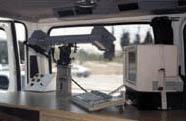 This is another new system which I've been told is entering service after successful trials
across the UK. It was invented by Jerry Ben Bavid, ex-head of the nuclear research
centre in Soreq and now CEO of Driver Safety Systems in Israel - the unit's
manufacturers. It entered service in Israel after a six month trial in Netanya.
MAROM is incredibly versatile using state-of-the-art electro-optic and infra-red
technologies.
It is an automated, lane-based traffic law enforcement
system that accurately measures the speed and tailgating (headway) distance
of each and every vehicle traveling in a given traffic lane. It operates
24 hours a day in all lighting and weather conditions. Violators are
photographed using high resolution digital cameras. The photographs,
along with all violation data, are stored on digital audio tapes (DAT) or WORM-CD.
This information is then relayed to the Data Processing Unit, which when connected
to the DVLA computers in Swansea, can automatically produce a virtually
unlimited number of violation notices per day.
This is another new system which I've been told is entering service after successful trials
across the UK. It was invented by Jerry Ben Bavid, ex-head of the nuclear research
centre in Soreq and now CEO of Driver Safety Systems in Israel - the unit's
manufacturers. It entered service in Israel after a six month trial in Netanya.
MAROM is incredibly versatile using state-of-the-art electro-optic and infra-red
technologies.
It is an automated, lane-based traffic law enforcement
system that accurately measures the speed and tailgating (headway) distance
of each and every vehicle traveling in a given traffic lane. It operates
24 hours a day in all lighting and weather conditions. Violators are
photographed using high resolution digital cameras. The photographs,
along with all violation data, are stored on digital audio tapes (DAT) or WORM-CD.
This information is then relayed to the Data Processing Unit, which when connected
to the DVLA computers in Swansea, can automatically produce a virtually
unlimited number of violation notices per day. The Marom emits two invisible infra-red beams across a given traffic lane
in order to measure the traveling behavior of a vehicle. The electro-optic
head directs the beams to two retro-reflectors mounted in the road surface.
Every vehicle passing between the electro-optic head and the retro-reflectors breaks
the two beams and triggers the unit's computer to measure speed, acceleration,
headway and vehicle length. In other words it can tell not only if you're speeding,
but also what type of vehicle you're in (car, truck, motorbike etc), and how close
you are to the vehicle in front! If a vehicle exceeds any of the pre-set parameters, the
high-res camera photographs the front or rear of the vehicle, including
its license plate and the driver's face.
The Marom emits two invisible infra-red beams across a given traffic lane
in order to measure the traveling behavior of a vehicle. The electro-optic
head directs the beams to two retro-reflectors mounted in the road surface.
Every vehicle passing between the electro-optic head and the retro-reflectors breaks
the two beams and triggers the unit's computer to measure speed, acceleration,
headway and vehicle length. In other words it can tell not only if you're speeding,
but also what type of vehicle you're in (car, truck, motorbike etc), and how close
you are to the vehicle in front! If a vehicle exceeds any of the pre-set parameters, the
high-res camera photographs the front or rear of the vehicle, including
its license plate and the driver's face. The Marom field unit is designed to offer huge configuration flexibility to the police.
It can be deployed at the roadside, mounted on an overhead structure (bridge, gantry, etc.)
either permanently or temporarily, or operated out of a parked vehicle.
The technology used in Marom is inherently immune to any known countermeasures,
such as radar and laser detectors. The technology is also insensitive to external
interferences such as electromagnetic interference (EMI) and other light sources.
Since it's creation, DSS have sold MAROM units all over the world, to countries
including Argentina, Costa Rica, France, Belgium, Germany and many states in
America.
The Marom field unit is designed to offer huge configuration flexibility to the police.
It can be deployed at the roadside, mounted on an overhead structure (bridge, gantry, etc.)
either permanently or temporarily, or operated out of a parked vehicle.
The technology used in Marom is inherently immune to any known countermeasures,
such as radar and laser detectors. The technology is also insensitive to external
interferences such as electromagnetic interference (EMI) and other light sources.
Since it's creation, DSS have sold MAROM units all over the world, to countries
including Argentina, Costa Rica, France, Belgium, Germany and many states in
America.Parts of text with permission of Driver Safety Systems
Multanova Multanova systems are starting to find their way to Britains shores now. I've had a few
emails from people describing these new units which they've seen and/or been caught by.
Multanova is a company based in Switzerland who specialise in traffic enforcement
systems. They have many products to catch out the unwary motorist, but
the ones you ought to know about are the Multanova 6F-2 and 9F - both radar-based
systems that can be installed in just about any manner you can imagine, including
pole-mounted, box-mounted, mobile, built-in to a vehicle and many others. These
people are creative, to say the least.
Multanova systems are starting to find their way to Britains shores now. I've had a few
emails from people describing these new units which they've seen and/or been caught by.
Multanova is a company based in Switzerland who specialise in traffic enforcement
systems. They have many products to catch out the unwary motorist, but
the ones you ought to know about are the Multanova 6F-2 and 9F - both radar-based
systems that can be installed in just about any manner you can imagine, including
pole-mounted, box-mounted, mobile, built-in to a vehicle and many others. These
people are creative, to say the least.
 Multanova's products work with off-the-shelf DRS-3 radar units in the Ka band radar - 34.36GHz and are mostly
used as mobile traps that can be set up on motorway bridges. The 6F-2 systems
take 4 or 5 speed readings before taking the photo, and can take up to 3 photos a second
using a fast motordrive camera system. The 9F systems extend this capability
to being able to determine the vehicle types as either trucks or passenger cars.
Both units can be configured either as a front- or rear-facing
trap. They are small, and from the front, look like miniature rocket launchers.
Multanova's products work with off-the-shelf DRS-3 radar units in the Ka band radar - 34.36GHz and are mostly
used as mobile traps that can be set up on motorway bridges. The 6F-2 systems
take 4 or 5 speed readings before taking the photo, and can take up to 3 photos a second
using a fast motordrive camera system. The 9F systems extend this capability
to being able to determine the vehicle types as either trucks or passenger cars.
Both units can be configured either as a front- or rear-facing
trap. They are small, and from the front, look like miniature rocket launchers.
 They are shielded to prevent external interference, and because of the highly targetted
radar beam (emitted via a parabolic reflector to allow focussing),
are almost entirely undetectable by over-the-counter radar detectors. There is one exception though.
The Australian Whistler claims to be able to detect these things from a good 300m away.
Read the 'testimonial' here. If you fancy trying
one of these out to let me know if it really works, www.radar.com.au sell them.
Chesire constabulary are rumoured to
have an undisclosed number of these products on test at the time of writing (April 99).
They are shielded to prevent external interference, and because of the highly targetted
radar beam (emitted via a parabolic reflector to allow focussing),
are almost entirely undetectable by over-the-counter radar detectors. There is one exception though.
The Australian Whistler claims to be able to detect these things from a good 300m away.
Read the 'testimonial' here. If you fancy trying
one of these out to let me know if it really works, www.radar.com.au sell them.
Chesire constabulary are rumoured to
have an undisclosed number of these products on test at the time of writing (April 99).Camera images with permission of Multanova AG
Robic SC-514 StopwatchYes, that's right, a £20 stopwatch. Type-approved and in use, predominantly by Hertfordshire police force (30-plus units!). Robic Chronometers are used to determine
the speed of a specific vehicle in the same manner as a VASCAR system, although with
a handheld stopwatch, the police officer can now be sitting at the side of the road
having a coffee for all you know. There's no radar, no loops, no tell-tale signs.
Just a plain and simple digital stopwatch, and two points a known distance apart. The officer
inputs the distance into the stopwatch (accurate to 1/1000th of a mile or km) and then just
presses 'Start', then 'Stop'. The Mk1 device shows the speed in the top-right corner
whilst the Mk2 device shows it in the main display area.
The display speed can be in either mph or kmh, the timing is accurate to 1/100 second (even
if the officer isn't), it can count 999 vehicles before needing to be reset, and never needs
calibrating. Oh, and it's back-lit so it can be used in the dark too. Stealth police!
They came into use originally with foot-patrols in estate areas.
Hertfordshire police force (30-plus units!). Robic Chronometers are used to determine
the speed of a specific vehicle in the same manner as a VASCAR system, although with
a handheld stopwatch, the police officer can now be sitting at the side of the road
having a coffee for all you know. There's no radar, no loops, no tell-tale signs.
Just a plain and simple digital stopwatch, and two points a known distance apart. The officer
inputs the distance into the stopwatch (accurate to 1/1000th of a mile or km) and then just
presses 'Start', then 'Stop'. The Mk1 device shows the speed in the top-right corner
whilst the Mk2 device shows it in the main display area.
The display speed can be in either mph or kmh, the timing is accurate to 1/100 second (even
if the officer isn't), it can count 999 vehicles before needing to be reset, and never needs
calibrating. Oh, and it's back-lit so it can be used in the dark too. Stealth police!
They came into use originally with foot-patrols in estate areas.
Marked VansI know this sounds daft, but plenty of police forces just use plain old marked white vans stuffed with any of the above equipment. If you see one of these sods parked at the side of the road, for God's sake slow down! It's more than likely to be a trap you fool!
![[van1]](northamptonvan1.jpg)
![[van2]](northamptonvan2.jpg)
Controlled Motorway IndicatorsThis system has been created by SERCo after they were subcontracted by Mouchel during the widening of the M25 London orbital carpark. It's use remains controversial. A similar system is in use on the continent, manufactured by Multanova AG in Switzerland. The system involves a series of gantries placed across the motorway. Each gantry contains computer controlled illuminator boards hooked up to a series of cameras on the far side, and traffic flow monitors on the front side. When the traffic flow monitors determine that they flow of traffic under the gantry is slowing down, a 60mph limit is imposed. The cameras on the far side activate, and the illuminated signs display a 60mph limit. The theory is
that congestion builds up because of a series of drivers who get too close to the car in
front and slow down. The cars behind see the brake lights and also slow down, but just that
little bit more. Before you know it, a mile back down the motorway, everything has come to a
grinding halt. The continuing theory is that by imposing a 60mph limit, everyone will
be forced to drive at that speed, thus eliminating the speed-up-slow-down behaviour which supposedly
causes the tailbacks. Unfortunately for the designers, their system actually
provokes more speed-up-slow-down driving than ever existed before as drivers slow
down for the gantry cameras and then speed up again on the other side.
The limit can be dropped as low as 40mph using this system.
on the far side activate, and the illuminated signs display a 60mph limit. The theory is
that congestion builds up because of a series of drivers who get too close to the car in
front and slow down. The cars behind see the brake lights and also slow down, but just that
little bit more. Before you know it, a mile back down the motorway, everything has come to a
grinding halt. The continuing theory is that by imposing a 60mph limit, everyone will
be forced to drive at that speed, thus eliminating the speed-up-slow-down behaviour which supposedly
causes the tailbacks. Unfortunately for the designers, their system actually
provokes more speed-up-slow-down driving than ever existed before as drivers slow
down for the gantry cameras and then speed up again on the other side.
The limit can be dropped as low as 40mph using this system.The cameras are derivatives of the fixed GATSO camera, but manufactured by a different company. There's one camera per lane, and each lane can have a different limit imposed on it. Mostly it just causes more congestion, chaos, accidents and raised tempers. 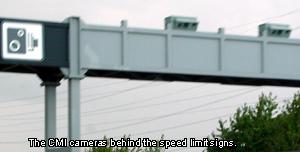 The chaos and accidents are caused because when the signs come on, there's no warning. With no
notice, a 60mph limit is suddenly imposed on a motorway where traffic can be flowing up to 85mph.
People jam on their brakes in an effort to slow down and accidents result. The raised tempers come
because on a clear motorway at night, the system has frequently glitched and forced 50mph limits
when there's been no traffic. Unfortunately, the powers that be have been very sparse with the
information ragarding that precise situation. To wit: in 1998 a court ruling was introduced that
indicated that the lower speed limits are only enforceable if the road conditions actually require
that lower limit. Or to put it another way, theoretically if you're whipping along at 80mph
at 3am on a completely empty motorway, and get caught by a glitched 50mph limit on these signs,
the police would now have to prove the need for the reduced limit in those conditions.
The chaos and accidents are caused because when the signs come on, there's no warning. With no
notice, a 60mph limit is suddenly imposed on a motorway where traffic can be flowing up to 85mph.
People jam on their brakes in an effort to slow down and accidents result. The raised tempers come
because on a clear motorway at night, the system has frequently glitched and forced 50mph limits
when there's been no traffic. Unfortunately, the powers that be have been very sparse with the
information ragarding that precise situation. To wit: in 1998 a court ruling was introduced that
indicated that the lower speed limits are only enforceable if the road conditions actually require
that lower limit. Or to put it another way, theoretically if you're whipping along at 80mph
at 3am on a completely empty motorway, and get caught by a glitched 50mph limit on these signs,
the police would now have to prove the need for the reduced limit in those conditions.
A.D.I.S.Technically, this isn't just a speedtrap, but a very versatile system designed to combat aggressive driving. ADIS=Aggressive Driver Imaging System. It's been developed in the USA for use on heavily congested routes where the number 1 complaint was aggressive driving. I've been led to believe that the Metropolitan police in the UK have an undisclosed number of ADIS units on test around the M25 motorway. The entire system can be hidden in a vehicle as small as a Ford Escort van, so if you see any "broken down" vans on the hard shoulder, be warned. ADIS uses a combination of still cameras, video cameras, LIDAR, and Autosense products.![[adis]](adis.gif) The LIDAR unit watches the oncoming traffic checking speed, whilst the front-facing video camera videos traffic activity. If a vehicle is determined to be speeding, it triggers the Autosense unit and the two other cameras. Autosense develops a vehicle profile using a line-scanning laser rangefinder which allows it to determine exactly what type of vehicle is being photographed. The side-view camera takes a photograph for reference of any distinguishing marks on the side of the vehicle (such as a truck's owner/operator) whilst the rear-facing camera takes photos of the vehicle's numberplate. Once the entire system is working together, it can, via all the photographs and video, determine if vehicles are speeding or if they've changed lanes within a short space of time. The Autosense unit adds the capability to determine if vehicles are tailgating - following too close to the vehicle in front. All these are traits of aggressive driving. In the USA, the system submits information to their equivalent of the DVLA, and an automated fine or warning is posted to the vehicle(s) owner(s). It's not clear yet how this will port to use in the UK as the system is still under test.
Redflex SmartcamSpeed![[redflex]](redflex.jpg) Redflex technologies, known better for their red-light enforcement
cameras, have jumped into the fray with the Redflex SmartcamSpeed
system. At the moment, this is neither in use, nor certified for
use in the UK but that doesn't mean it won't find it's way
over here.
Redflex technologies, known better for their red-light enforcement
cameras, have jumped into the fray with the Redflex SmartcamSpeed
system. At the moment, this is neither in use, nor certified for
use in the UK but that doesn't mean it won't find it's way
over here.Redflex couple their own Sony-derived high resolution digital camera system (1050 x 1434) with one of three off-the-shelf solutions:
|
||
![[lti2020]](lti2020.jpg) A June 1996 court case in the United States
threw doubt on the accuracy of the LTI20.20. The prosecution was successfully
massacring the defence when they came to a recess in the proceedings. At this
point, the defendant's lawyer picked up the LTI20.20 from the courtroom bench
and proceeded to aim it at the back wall of the courtroom. To his complete
astonishment, the gun registered a speed of 4mph. Bear in mind that he was
aiming at a wall inside a building! At this point, the whole
line of defence changed and in the end, the defendant managed to successfully
prove that not only was the gun too heavy to use to reliably pick out
a vehicle at 150metres without a tripod, but that
it's technology was fundamentally flawed.
If you're interested to see how this case set a precedent in the USA, read the full article
A June 1996 court case in the United States
threw doubt on the accuracy of the LTI20.20. The prosecution was successfully
massacring the defence when they came to a recess in the proceedings. At this
point, the defendant's lawyer picked up the LTI20.20 from the courtroom bench
and proceeded to aim it at the back wall of the courtroom. To his complete
astonishment, the gun registered a speed of 4mph. Bear in mind that he was
aiming at a wall inside a building! At this point, the whole
line of defence changed and in the end, the defendant managed to successfully
prove that not only was the gun too heavy to use to reliably pick out
a vehicle at 150metres without a tripod, but that
it's technology was fundamentally flawed.
If you're interested to see how this case set a precedent in the USA, read the full article


![[loops]](loops.jpg)
![[roadmarks]](truvelo2.jpg)
![[actual photo]](speedcheckphoto.jpg)